

Something has shifted in how people fly short-haul. As airlines have unbundled their fares and started charging for overhead locker space, more travellers are leaving the cabin case behind and flying with a single underseat cabin bag: the one personal item that is still included free. What began as a money-saving workaround has become a deliberate way to travel, with bags now designed specifically to maximise every centimetre of that free allowance.
Why the personal item became the whole luggage
The logic is simple. On the lowest fares, the personal item is the only bag included; everything else, from a 10kg cabin bag to a checked suitcase, is an add-on. For a two or three night trip, paying for locker space can feel hard to justify when a well-packed under-seat bag covers the essentials. There are side benefits too: no queueing at bag drop, no wait at the carousel, no risk of your bag being gate-checked into the hold, and everything stays within reach during the flight. The trade is discipline: you pack less, and you pack deliberately.
What counts as an underseat cabin bag
An underseat cabin bag is any bag small enough to fit in the space under the seat in front of you, within your airline's published personal item size. The awkward part is that there is no single standard. Ryanair allows 40 x 30 x 20cm, easyJet is more generous at 45 x 36 x 20cm, Jet2 allows 40 x 30 x 20cm, while British Airways limits its hand bag to 40 x 30 x 15cm. We compared all four in detail in our guide to hand luggage sizes across UK airlines. A bag built exactly to the 40 x 30 x 20cm size is the most versatile choice: it qualifies as the free personal item on Ryanair and Jet2 and sits comfortably inside easyJet's allowance, though it is too deep for BA's slimmer hand bag limit.
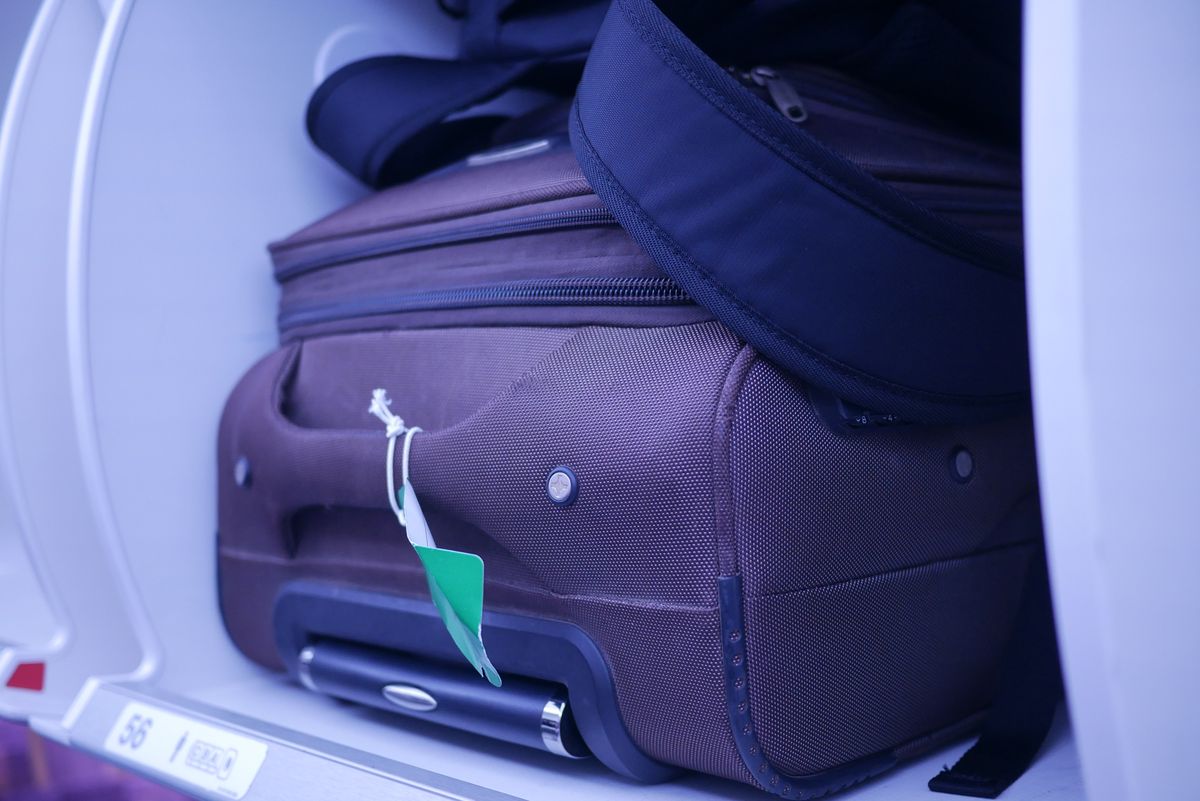
What realistically fits in 40 x 30 x 20cm
Work from the dimensions rather than the marketing. A 40 x 30 x 20cm bag gives you roughly 24 litres of total volume, and once you allow for the bag's own structure, zips and laptop padding, the usable packing space is less than that. In practical terms, that space typically covers a long weekend packed tightly: two to three days of clothing with items rolled rather than folded, one spare pair of light shoes at most if you wear your bulkiest pair to travel, a wash bag that respects the liquids rules, and tech such as a laptop in a padded sleeve, charger and headphones. What does not fit is just-in-case packing: a second coat, full-size toiletries or a separate outfit for every evening. Choosing versatile pieces that mix and match is what makes personal-item-only travel work.
What to look for in an underseat bag
Start with exact external dimensions, including handles and straps, and pick a bag designed to the size rather than a standard bag squeezed down. A wide, clamshell or suitcase-style opening makes packing far easier than a top-loading design. A padded laptop sleeve matters if you work on the move, and a trolley sleeve that slides over a suitcase handle is worth having for trips where the underseat bag becomes your second bag instead of your only one. You can see both styles in our cabin and travel bags and our backpacks collection, where dimensions are listed on every product.
Who it suits, and who it does not
Personal-item-only travel suits short city breaks, overnight business trips and anyone who values boarding fast and walking straight out of arrivals. It suits travellers who can rewear outfits and keep toiletries minimal. It does not suit longer holidays, trips needing formal wear or sports kit, or anyone who brings back more than they took out. For those trips, the underseat bag still earns its place as the free companion to a cabin or checked case.
The underseat cabin bag has gone from compromise to strategy: the right size, packed well, turns the free personal item into all the luggage a short trip needs. Browse our underseat and cabin bags to find one matched to your airline's exact allowance.